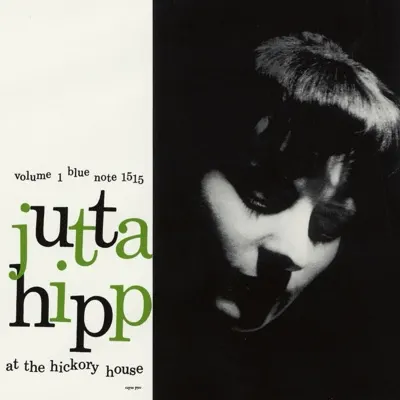
Jutta Hipp was born in Leipzig in 1925. She studied painting, listened to jazz in secret under the Nazis, and after the war became one of West Germany's best-known pianists. Leonard Feather heard her in Duisburg in 1954 and recorded her quintet in Frankfurt that spring. She moved to New York in November 1955, and in March 1956 she opened at the Hickory House on 52nd Street, a run that lasted six months.
The tenor player was an old acquaintance. Feather, in the original notes, says she and Zoot Sims had met a couple of years before, when Sims was touring Europe with Stan Kenton and the two of them jammed in a Frankfurt cellar. In New York they met again during the Hickory House run, and this date grew out of it.
The date was Saturday, July 28, 1956, at Van Gelder's in Hackensack, with Alfred Lion producing. On trumpet was Jerry Lloyd, from Sims's own group, who Feather says had once driven a cab. Ahmed Abdul-Malik played bass and Ed Thigpen, Hipp's drummer, played drums. Eight tunes were taped and six made the record. They are long, loose performances, and Feather felt they captured a club set:
everything is there but the audience applause
Leonard Feather, original liner notes
Side one opens with "Just Blues," a 12-bar blues credited to Sims. He takes the first 11 choruses, Lloyd about seven, and then Hipp. "Violets for Your Furs" is mostly Sims and Hipp, with Lloyd coming in near the end. The third tune is "Down Home," credited to Lloyd; Feather calls it "Back Home," and hears in it a trip along the familiar chords of "Indiana." On side two, J.J. Johnson's "Wee-Dot" is a fast blues that runs to 37 choruses of long turns for Sims, Hipp and Lloyd. "Too Close for Comfort," from the Broadway show Mr. Wonderful, closes the record at a medium pace.
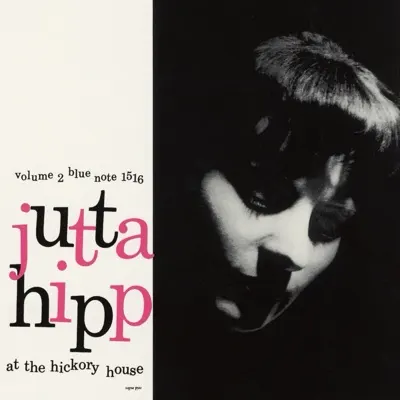
The sleeve was designed by Reid Miles. Blue Note released the record in February 1957, and the two tunes left over, "These Foolish Things" and "'S Wonderful," waited until a Japanese Blue Note set in 1984.
It was Hipp's last session for the label. Stage fright and drink made playing hard, and she fell out with Feather. By 1958 she had stopped playing, and she spent the next 35 years as a seamstress for a clothing company, and went back to drawing and painting. Reviewing this record for AllMusic, Scott Yanow and Thom Jurek put the question plainly:
one has to wonder why Hipp simply dropped out of the jazz world
Scott Yanow and Thom Jurek, AllMusic, quoted on Wikipedia