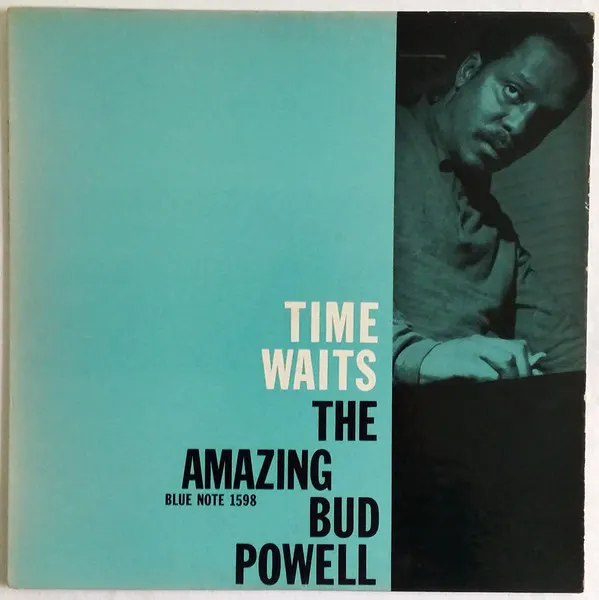
Bud Powell had been making records for Blue Note since 1949, and Leonard Feather, in the original notes, gives the label's founders, Alfred Lion and Francis Wolff, the credit for his loyalty. Feather is frank that Powell was a sensitive man with emotional problems, and that how a session went depended on who was in the room, on being free to choose his tunes and tempos, and on
the need to feel wanted, understood and appreciated by those for whom he is working
Leonard Feather, original liner notes
Feather's main point is that Powell was a composer as much as a pianist. He had written "Un Poco Loco" and "Glass Enclosure" for the label years before. This record went further.
The present album is the first for which Bud formally composed all the tunes
Leonard Feather, original liner notes
The date was Saturday, May 24, 1958, at Van Gelder's in Hackensack. The Jazz Tome's page gives May 25; the session listing and Wikipedia have the 24th. Sam Jones, ten days after Kenny Burrell's Blue Lights date, played bass, and Philly Joe Jones drums. Feather says it was the first time either had recorded with Powell. Only the opening and closing themes were written out; Powell told the bassist some of the chords, and the rest was made up on the spot. Nine takes were made, and eight are on the record.
Side one opens with "Buster Rides Again," a blues with a Latin tinge. Sam Jones sets up a rhumba beat, and Philly Joe gets a solo. "Sub City" is a 32-bar theme at a medium-bright tempo, with a bass solo over brushes. "Time Waits," the title tune, is the only ballad; Feather thought it could take a lyric, the way "'Round Midnight" did. "Marmalade" is a boppish line, with a joke quote from Raymond Scott's "Toy Trumpet" before the bass solo. On side two, Feather hears Thelonious Monk in the theme of "Monopoly." "John's Abbey" is fast, in the line of Charlie Parker's tunes of the 1940s. "Dry Soul" is a very slow blues that reminded Feather of Avery Parrish's "After Hours." A short second take of "Sub City," without the bass and drum solos, closes the record.
The sleeve is Reid Miles's design, with photography by Francis Wolff.
Ralph J. Gleason, in the San Francisco Chronicle, called it "undoubtedly the best work Powell has recorded in several years." An alternate "John's Abbey" waited for a later Blue Note LP. Powell came back to Van Gelder's on December 29, 1958, for one more trio date, The Scene Changes.