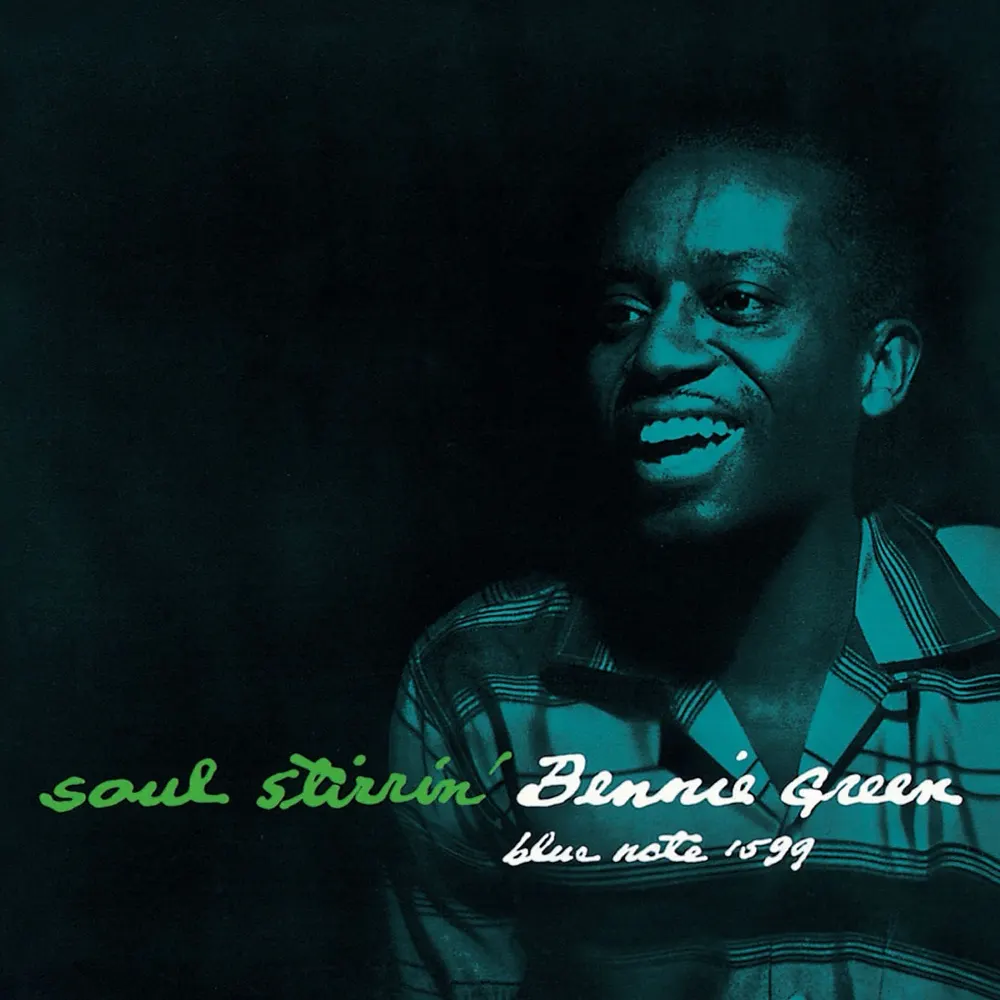
Bennie Green was a trombonist from Chicago. Jack Walker, in the original notes, tells how Budd Johnson found him for the Earl Hines band in 1942. He spent three years with Charlie Ventura, where his solos got him noticed, went back to Hines, and then led his own groups. Walker hears Trummy Young in his sound. Five weeks before this date Green had made Back on the Scene for Blue Note, with Charlie Rouse on tenor. This time he came back with two.
The date was Monday, April 28, 1958, at Van Gelder's in Hackensack, with Alfred Lion producing. The tenors were Gene Ammons, named in the notes only as "Jug," and Billy Root. Sonny Clark, four weeks after Louis Smith's Smithville, was on piano, with Ike Isaacs on bass and Elvin Jones on drums. The singer Babs Gonzales wrote two of the tunes and sings on the first two. Walker says the arrangements were by Melba Liston, then recently with Dizzy Gillespie's big band. Seven takes were made, and six are on the record.
Side one opens with Gonzales's "Soul Stirrin'." Gonzales and Green sing a short introduction, then Green, Ammons, Clark and Root solo in turn. "We Wanna Cook" is Green's own, up-tempo, and Walker links it to his earlier "I Wanna Blow." "That's All" is the only standard, a ballad. Green plays the melody and Ammons follows.
for his horn truly is singing
Jack Walker, original liner notes
Side two starts with Gonzales's "Lullaby of the Doomed," which Walker hears as a modern piece, with solos from Green and Ammons. "B.G. Mambo" is Green's Latin number. The record closes with "Black Pearl," by the saxophonist Billy Graham, with Green, Ammons, Root and Clark all taking a turn.
This melodic work, highly listenable, and – if you like – danceable, is the perfect icing.
Jack Walker, original liner notes
The sleeve is Reid Miles's design, with photography by Francis Wolff.
The reviews were mixed. Billboard gave it two stars, and Martin Williams, giving three in Down Beat, heard everything from burlesque to good jazz. Later, at AllMusic, as Wikipedia quotes him, Stephen Thomas Erlewine called it "an invigorating, exciting date from trombonist Bennie Green, showcasing his wide range of skills."
A second take of the title tune went to the stereo edition. Green was back with Blue Note in November 1958, and Gonzales came with him.