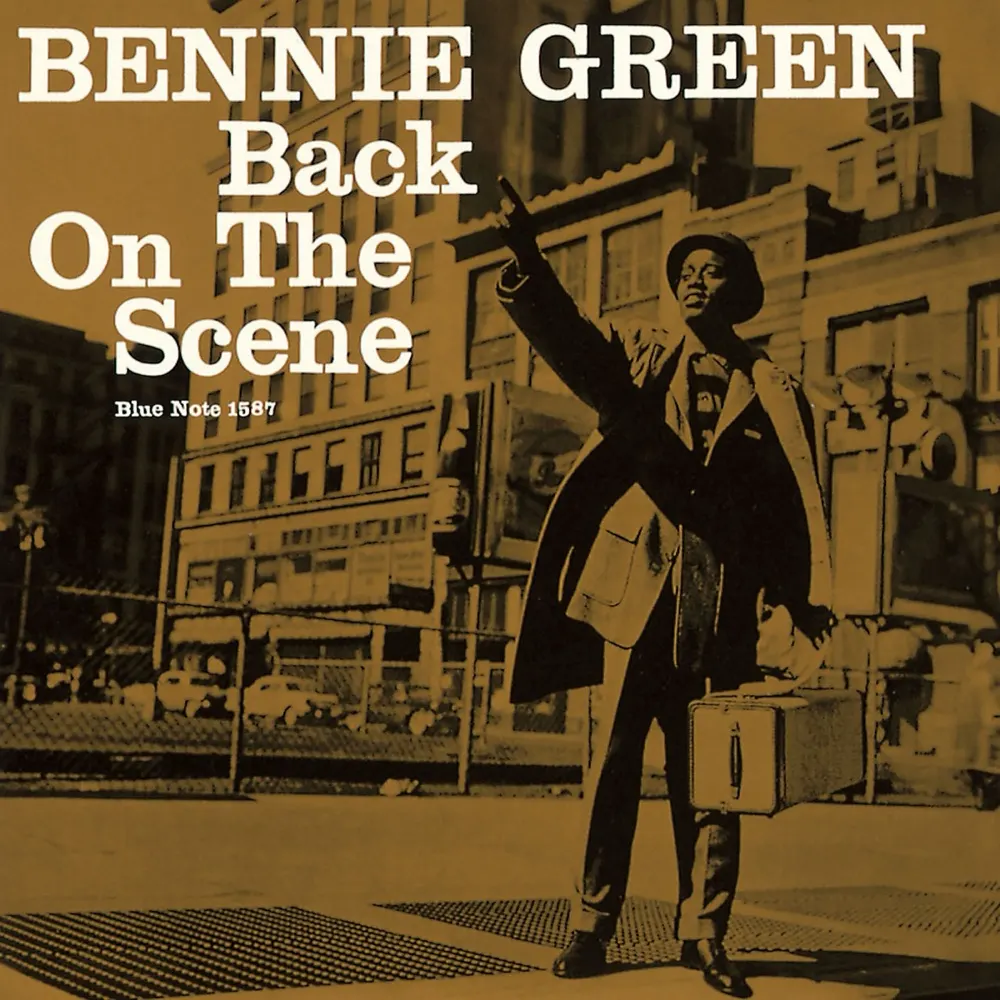
Bennie Green was born in Chicago in 1923, and his first model on trombone was Trummy Young of the Jimmie Lunceford band. In 1942 he joined Earl Hines, in the band that also held Dizzy Gillespie and Charlie Parker, and after two years in the Army he went back to Hines. Then came almost three years touring with Charlie Ventura, and from 1953 a quintet of his own. Leonard Feather, in the original notes, walks through all of it, including up-tempo blues of Green's like "Blow Your Horn," with the heat of a Jazz at the Philharmonic jam. He does so because of Green's "recent absence from the spotlight," and the title says the rest. Cashbox noted that this was his first record as a leader for Blue Note.
The date was Sunday, March 23, 1958, at Rudy Van Gelder's in Hackensack. Charlie Rouse, who had played in Green's group in 1955, was on tenor. Joe Knight, a Brooklyn pianist who had worked with Hot Lips Page and Earl Bostic, played piano. George Tucker played bass, and Louis Hayes, the young drummer Horace Silver had found, played drums. Six tunes, six takes, and all of them made the record. Two came from Melba Liston, who had been playing and writing for Gillespie's big band.
Side one starts with Cole Porter's "I Love You," set on a Latin figure. Green takes the first long solo, then Rouse, then Knight. Liston's "Melba's Mood" is in a minor key, with Green on mute. "Just Friends" goes fast; Feather singles out Rouse's solo and hears Sonny Rollins in it.
Side two opens with "You're Mine You," a tune J.J. Johnson had already recorded for Blue Note. Then the blues. The Jazz Discography Project lists it as "Bennie Blows the Blues," while Wikipedia and the Jazz Tome page have "Bennie Plays the Blues." Whatever the name, Green plays about 13 choruses before Rouse and Knight take over. Liston's "Green Street," a 32-bar tune, closes the record, and Feather thought both horns did some of their best playing of the day on it.
The photography is by Francis Wolff.
Stephen Thomas Erlewine, at AllMusic, called it "one of Bennie Green's most diverse efforts." Blue Note put four of the six tunes out on two singles. Five weeks later Green was back at Van Gelder's with a bigger band, for Soul Stirrin'.