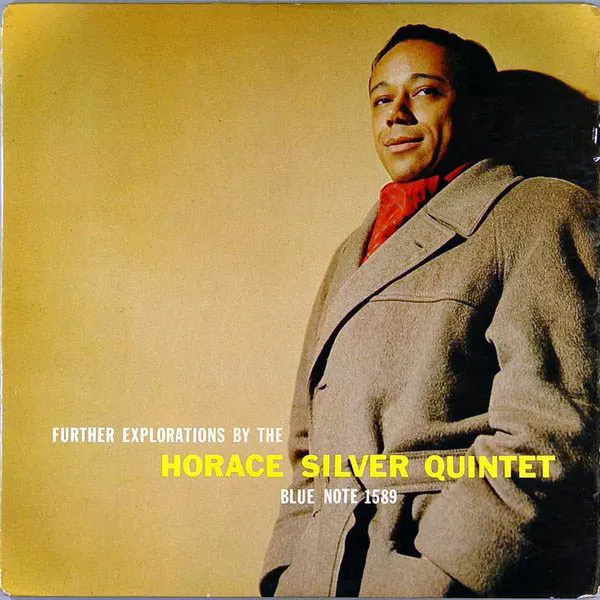
Leonard Feather, in the original notes, sorts musicians into two kinds. Some made their names by opening up new sounds for bands and instruments, and they can explore sideways. Others are known for a personal solo style, and they explore by digging down into it. He puts Horace Silver in the second group. The title says the same thing. These are explorations, but from home ground.
By early 1958 Silver's quintet had settled. Art Farmer had been on trumpet from the start, apart from a short spell when Donald Byrd filled in. Louis Hayes had been on drums almost since the group formed in the late summer of 1956. Cliff Jordan came in on tenor in the summer of 1957, in what Feather calls a trade with Max Roach, who took Hank Mobley. Teddy Kotick had replaced Doug Watkins on bass more than a year before. This band played Birdland in February 1958.
The date was Monday, January 13, 1958, at Rudy Van Gelder's in Hackensack, with Alfred Lion producing. The take count ran to 21, and six tunes were kept, five of them Silver's.
Feather spends his space on the shapes of the tunes. Side one opens with "The Outlaw," built on a 13-bar line played twice, then a 10-bar channel, a 16-bar vamp and a two-bar break before Jordan takes the first solo. "Melancholy Mood" is a ballad for the trio alone, in seven-bar phrases, with Kotick bowing in the first chorus. "Pyramid" is a minor unison line, and Farmer solos first.
Side two starts with the longest piece, nearly 11 minutes. Feather and Wikipedia spell it "Moon Rays"; the Jazz Discography Project has "Moonrays." The two horns play in two-part harmony over pedal points, and Silver called it:
a sort of walking ballad
Horace Silver, in Leonard Feather's original liner notes
"Safari" is much older and much faster.
Safari is a minor bop line written by Horace some eight or nine years ago
Leonard Feather, original liner notes
Feather picks out Jordan among the soloists, and Hayes gets a short spot. The record ends with Harold Arlen's "Ill Wind," taken at a moderate swing, with Hayes doubling the rhythm behind the piano solo.
The sleeve is a Reid Miles design with photography by Francis Wolff. Blue Note paired "The Outlaw" and "Safari" on a single, and the album was out by early May. Steve Leggett, at AllMusic, later called it "a solid, even striking outing."
When Silver made Finger Poppin' a year later, Hayes was still at the drums, but Blue Mitchell, Junior Cook and Gene Taylor had taken the other chairs.